A Light in Dark Times | Gen Doy
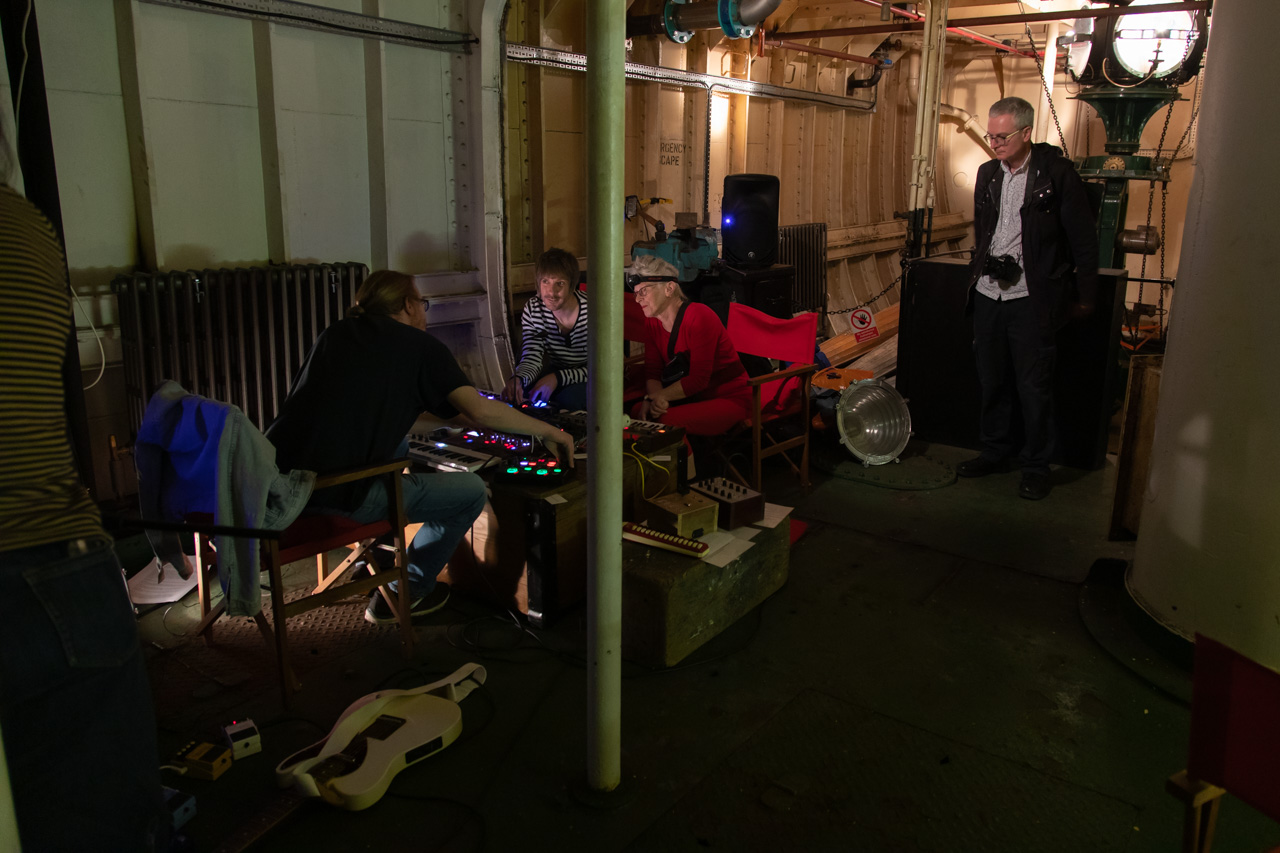
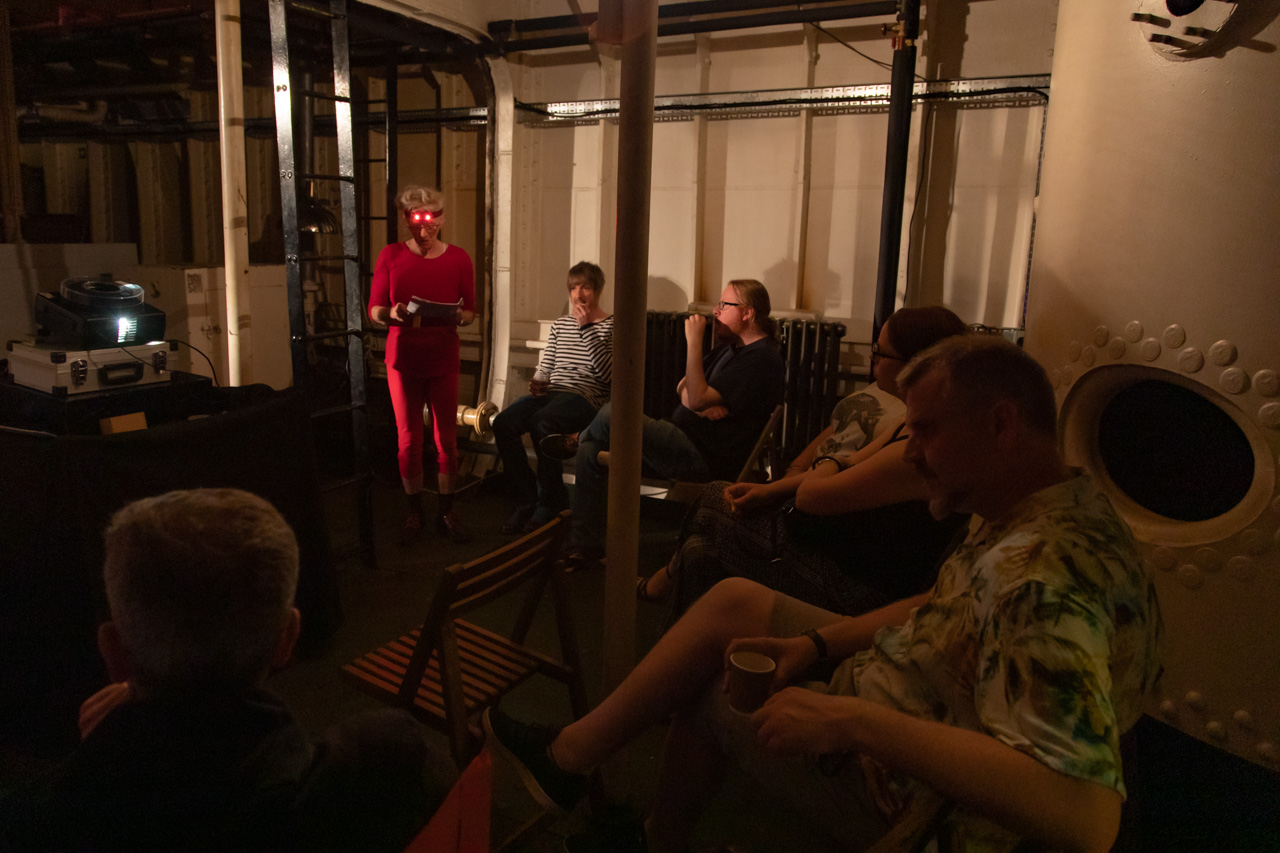
Artist Gen Doy took up residency in the lower deck of the ship experimenting with sound and projection based on events seen in the estuary surrounding the ship and relating to nationality, migration, acceptance and notions of citizenship, including the arrival of The Empire Windrush, carrying some 500 settlers from Jamaica, at Tilbury Dock on 22 June 1948.
This ship, the LV21, was built in 1963. Like other lightships and lighthouses, its purpose was to be seen by passing vessels to warn them of hazardous rocks or sandbanks. Many also had foghorns of which there were 3 main types. This one I’m going to demonstrate sounded something like a very annoyed crow.
Early lightships were described as “curious, almost ridiculous craft among the aristocracy of shipping…distinguished in daylight by a large ball at its masthead, and at night …. by a magnificent lantern, with Argand lamps and concave reflectors, which shoots like lightening far and wide over the watery waste” .
A nineteenth-century writer remarked,
“Short in length, bluff in the bows, round in the stern, and painted all over, except the mast and deck, in a bright red colour, like a great scarlet dragon, or a gigantic boiled lobster…it never advanced an inch on its course, for it had no course. It never made for any port. It was never either homeward or outward bound…its doom was to tug perpetually, day and night, from year to year, at a gigantic anchor which would not let go, and to strain at a monster chain-cable which would not snap-in short, to strive forever, like Sisyphus, after something which can never be attained. “
The lightship crew, at quiet times, could look up to the night sky and see the planets Mars, Mercury, Venus, Jupiter and Saturn. Constellations of luminous stars seen and named by ancient astronomers reassuringly reappeared when the skies were clear, night after night , year after year.
Crewmen, for they seem to have always been men, may have wondered whether there was a plan to the universe, whether there was life elsewhere, or even what would happen if the earth became uninhabitable. Was there perhaps an unlikely planet B?
But the lightship is not only something to be seen, it also sees... And in response to what it sees, it shines out its light to illuminate the truth in dark times and sounds its horn in warning.
The lightship can see who is coming, who is going, who is welcomed with open arms in time of need, and who is viewed with suspicion like so-called aliens from another planet - from another way of life.
The Empire Windrush, a former cruise ship and German WW2 troop ship, arrived from Jamaica in Tilbury docks on June 22nd 1948, so today is the 71st anniversary of this important event in the history of migration to Britain. Britain was in need of labour to rebuild after the war and staff the newly founded NHS, and Caribbean migrants came to meet that need as well as further their own ambitions. Dressed in their best they arrived at Tilbury with Black style in spades, calypsos, and wide-lapels on their suit jackets. The men sported trilby or fedora hats and the women wore smart hats, gloves and dresses that many of them had made themselves on domestic sewing machines.

But the Windrush generation were not the first “exotic” migrants to navigate their way past the maritime hazards and warning beacons of the Thames estuary.
In Gravesend near the church of St. George is the statue commemorating Pocahontas, a native north American princess who married an Englishman and returned to England with him, sadly dying very young and buried here. Pocahontas was a welcome visitor... young, exotic, a curiosity… a baptised Christian who dutifully changed her name to the biblical Rebecca, and a friend to the colonists in north America. Referred to as “ la belle sauvage” or the beautiful savage, Pocahontas/Rebecca has now become an economic benefit to Gravesend, as tourists come to visit her statue and learn more of her short experience of immigration.
The mouth of the Thames estuary saw the arrival of “migrants”, but the departure of “settlers” or “colonists” to North America or Australia. The lightship pauses to reflect and illuminate …
A more recent heroic migrant citizen is commemorated in a nearby memorial just outside the LV21. This bronze statue honours the late Squadron leader Mahinder Singh Pujji and all those from around the world who served alongside Britain in its wars.
However the most recent migrant who brought tourists to the estuary was Benny the beluga whale. In 2018 the white whale, more of a good omen than was Moby Dick, appeared in the Thames estuary and is still thought to be alive though she or he has not been sighted recently. Benny doesn’t need a lightship to navigate but the busy estuary is not the ideal place for this migrant mammal, who may have returned northwards to the Arctic and “home”. Benny held up work on a road tunnel under the Thames, and drew visitors to Gravesend, where The Ship and Lobster pub welcomed a rise in customers. But some Belugas are not such welcome visitors. One was reported by the Metro newspaper on April 30th 2019 to have been found by Norwegian fishermen with a camera harness made in Russia, and possibly therefore a Russian spy.
Yet these migrants seen safely ashore by the lightship, contributing to the public good, the economy, and even our own survival, are not always welcome. Further down the Kent coast migrants, many seeking asylum and crossing the channel from Northern France have been intercepted by Border control officers. Some politicians have called for strong action and described this as a crisis. Children of the Windrush generation have recently been deported, lost their jobs, and denied cancer treatment since they supposedly do not have the rights of citizens. At least 11 of those deported have since died (according to figures given by Sajid Javid quoted in The Guardian November 2018, and the recent article on the Windrush scandal in The Guardian 22 June 2019) .
As the waves break on the shores, and tides move with forces outside our control, the lightship sees the changing threats of climate and natural disasters. But it cannot influence human responses, only warn of dangers.
In Alan Bennett’s play Allelujah! A migrant doctor facing deportation addresses the audience saying “ Unwelcome on these grudging shores, I must leave the burden of being English to others and become what I have felt, a displaced person… Open your arms before it’s too late”.
Song…. to the tune of Sea of Heartbreak , sung by Don Gibson 1961
Dum dum dum dum
Da da da dum
The lights in the harbour
Dum dum dum
Don’t shine for me
Dum dum dum dum
I’m just a lightship…
Dum dum dum
Anchored at sea….
Sea of darkness,
Lost jobs, loneliness
Always more…. homelessness,
So unkind…. policies that are blind to poverty
I’m on this sea of tears,
Sea of darkness.
Dum dum dum dum
Here in the darkness
Dum dum dum
I’m shining a light
Dum dum dum dum
Showing what’s happening
Dum dum dum
Can we put it right?
Sea of darkness
plastic waste… washed ashore
huge cruise ships causing more
global warmth, ….lifestyles that …in the end will cost us dear,
I’m on this sea of fears,
Sea of darkness.
Oh what I’d give for a citizenship,
Able to take more control……
Come to my rescue.
Dum dum dum
Like migrants at sea,
Dum dum dum dum
Benny was welcome,
Dum dum dum
So why reject me?
Sea of darkness
Lost jobs, loneliness
Always more homelessness
So unkind, policies that are blind to poverty,
I’m on this sea of tears,
Sea of darkness.
Sea of darkness, aah
Sea of heartbreak
Sea of heartbreak aah
Sea of heartbreak
For more informstion about Gen Doy visit: